Take-home sales at the grocers increased by 2.2% in the four weeks to 1st November 2026 compared with a year ago, according to our latest data. Like-for-like grocery price inflation remains relatively subdued but rose slightly to 2.6%, up from 2.5% in the previous four weeks.
Grocery price inflation continued to increase after slowing over the summer. While prices are rising at a slower rate than at the beginning of the year, the direction of travel has changed. Household budgets have already taken a hit after the latest increase to the energy price cap arrived with the cold weather in October, and shoppers will be keeping a close eye on prices at the tills this winter.
Shoppers heed government’s ‘Be Ready’ advice
Sales of essential supplies jumped in the ten days from 22nd October after the launch of the government’s ‘Be Ready’ public awareness campaign, which encourages households to prepare for up to three days in the event of disruption to essential services.
In the ten days after the campaign was launched, sales of hand sanitiser increased by 83% compared to the corresponding period last year, with sales of bottled water (+67%) and tinned and jarred goods (+37%) also rising. The number of people buying tinned meat each day after the launch of the campaign rose by 43%, equivalent to an extra 400,000 shoppers a day, yet the typical amount bought remained at around 500g in terms of pack size.
Shoppers clearly took notice of the ‘Be Ready’ campaign, but this wasn’t panic buying, with less than a third of households buying bottled water in October. Growth came from more people adding the recommended items on the government’s checklist to their weekly shop, not from shoppers piling their trolleys high, which is very much in line with what the government wanted households to do.
Price of a pumpkin drops as shoppers get into the Halloween spirit
Over the month of October, 3.3 million households purchased a pumpkin, with the number sold up 10% year on year. The average price paid for a pumpkin stood at £1.20, 12% lower than last year, providing some small but welcome relief for shoppers looking to celebrate Halloween.
Tubs of sugar confectionery were the standout ‘trick or treat’ performer, with sales up by 28% compared to last year.
Retailers enter ‘golden quarter’ with Black Friday on the horizon
Retailers are now firmly in the so-called ‘golden quarter’, the peak spending period comprising major commercial events including Black Friday, Cyber Monday and Christmas.
Despite pressure on household budgets, Black Friday week remains one of the biggest moments in the shopping calendar, and shoppers spent £4.4 billion across general merchandise categories last year, up 1% on the previous year and nearly double total spend in an average week.*
Many households will be planning their Christmas spending more carefully this year, making Black Friday an important moment for shoppers looking to make their money go further on big-ticket items, while retailers will be hoping it gets the golden quarter off to a strong start.
Ocado delivers joint record market share
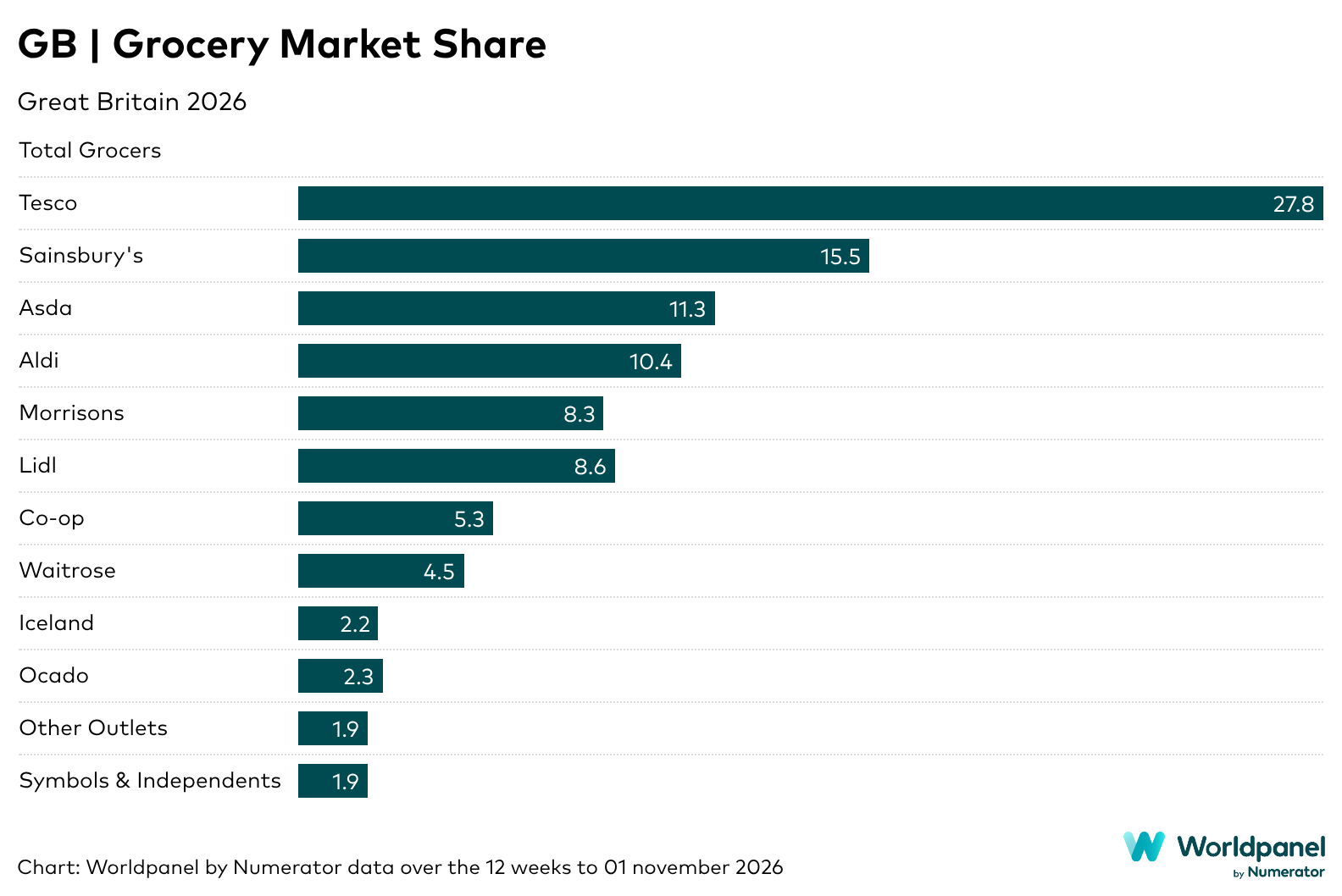
Sales at online-only grocer Ocado grew by 12.3% over the 12 weeks to 1st November 2026 versus the same time a year ago. This represents the 30th consecutive period of double-digit growth, and the online-only specialist achieved a joint record market share of 2.3%, up from 2.1% in 2025. M&S, part owner of the Ocado retail business, separately increased grocery sales through its stores in the same time period by 14.6%.**
Spending through the tills at Lidl increased by 6.6%, resulting in a market share gain of 0.4 percentage points, the greatest of any retailer, and it now accounts for 8.6% of all sales. The third retailer to increase share compared with last year was Waitrose, moving up to 4.5% from 4.4% as sales rose by 2.2%.
Sales at Morrisons rose by 2.0%, slightly ahead of the market, delivering a stable market share of 8.3%. Tesco, Britain’s largest grocer, now commands a 27.8% share, with sales 1.2% higher over the latest 12 weeks. Meanwhile, sales at Sainsbury’s increased by 0.8% to give a share of 15.5% - the highest since April.
New Asda CEO David Potts starts his role with a market share of 11.3%, as more than half of households shopped in its stores or online over the last three months.
Sales were up by 0.4% at Aldi, Britain’s fourth largest grocer, taking share to 10.4%. Co-op’s sales were 0.7% higher than a year ago, meaning the convenience specialist now accounts for 5.3% of the market, while Iceland takes a 2.2% share.
*Worldpanel Plus w/e 30 November 2025. Categories included: appliances , consumer electronics , toys , beauty , fashion, pet , toiletries , gifts , homeware & arts & crafts & entertainment. All retail outlets including online.
**참고: M&S는 매출 구성에서 의류 및 일반 상품의 비중이 높아, 월드패널 식료품 시장 점유율 발표의 근거가 되는 '계산대 영수증 방법론'을 적용할 때 '식료품점' 정의에 해당하지 않습니다. 이에 따라 M&S에 대한 비교 가능한 시장 점유율 수치는 제공되지 않습니다. 본 업데이트에서 인용된 M&S 성장 수치는 FMCG(일상 소비재) 매출만을 반영한 것이며, 식료품점 시장 점유율 표의 식료품점 관련 수치는 슈퍼마켓 계산대를 통한 총 지출을 포괄합니다.

프레이저 맥케빗
Worldpanel by Numerator 소매 및 소비자 인사이트 부문 책임자